On this page, you can find the most common topics in the questions we receive from our customers.
Please choose the theme you are interested in and let’s hope you find the answer.
If not, please send your question via the contact form.


On this page, you can find the most common topics in the questions we receive from our customers.
Please choose the theme you are interested in and let’s hope you find the answer.
If not, please send your question via the contact form.
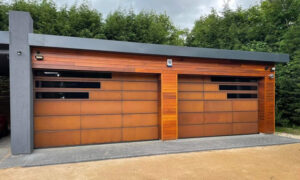
All garage doors are made to serve. But when it comes to deciding which garage door type to choose you must take into account how big is your garage opening, do you need a very specific design (especially in conservation areas), and usage purpose (car, storage space, workshop, hobby space).
We offer three types of garage doors: sectional, side-hinged and side sliding. Each type has specific technical requirements and limitations. Consult your local professional garage door dealer for the best option.
Sizes: sectional & side-sliding up to 6 metres wide, 3 metres high. Side-hinged up to 3 metres wide, 3 metres high.
All door types are made to measure. Upon request, we can manufacture garage doors bigger than the sizes indicated above.
Sectional doors are moving up/down and are placed under the ceiling in the open position, do not require any space in front or behind the garage door to operate. Can be automated.
Side-sliding doors are moving left/right side and are placed along the side wall in the open position, do not require any space in front or behind the garage door to operate. Can be automated. For wide openings, we recommend bi-parting doors.
Side-hinged garage door leafs require space on the opening side and automation is not recommended due to safety issues.
Ryterna manufactures 2 basic types of front doors. Aluminium doors are marked as RD 80 or RD100 with the leaf thickness 80 and 100 mm correspondingly, and steel doors RD67 with leaf 67 mm thick. Aluminium front doors offer the ultimate U-value and most of the design possibilities. RD67 is a cheaper alternative to aluminium doors without compromising the quality.
All Ryterna garage doors are made to order. The door size range is shown in the price-list cover about 95% of all domestic garage door sizes. But we manufacture extra-large garage doors as well. So if you have to install new or replace an existing door which is exceeding the standard range, please contact us or one of our dealers. We can build the doors for openings up to 11 metres wide and up to 11 metres high.
We offer a wide range of standard colours including several wood image colours. Even though the standard range is not enough, we can spray panels in custom colour. You can pick almost any colour from RAL, NCS or BS colour charts including metallic or pearl finish.
The very frequent question about BS 14 C 35 – ‘Chartwell Green’ colour finish. The answer is yes- we can paint side-hinged and sectional garage doors in ‘Chartwell Green’ colour. This is one of our favourite colours so we use the original ‘Chartwell Green’ instead of an almost-matching RAL substitute.
Due to our cutting-edge technology, the company offers doors clad with engraved metal sheets, okoume plywood or hardwood, and laser-cut standardized or individual decorative metal decals like a house number, decorative motifs, family coat of arms, etc.
The 10-year warranty is granted for Ryterna garage door sections against rust–through perforation, delamination, and disintegration.
A 5-year warranty is given for wearing parts such as springs, cables, drums, rollers, and hinges on residential sectional garage doors TL, R40 under normal use.
Normal use is estimated to be 4 open/close cycles per day, which is about 1500 cycles a year.
5-year warranty on springs, cables, drums, rollers, and hinges on industrial sectional doors TLP under normal use up to 10 open-close cycles per day.
For nonstandard colour painted doors and doors clad in Okoume, Retro, Alumax and other special design doors, the 2-year warranty period is applied.
Visual inspection of door panels should be done at a distance not less than 3m from the door.
2-year warranty for wearing parts of SH1, SH2 and SSD type doors.
Front doors are granted a 5-year warranty in general.
Ryterna doors are low-maintenance products. The moving mechanisms, like springs, cables, pulleys, rollers, hinges, locks, etc., require regular maintenance procedures. This helps to increase garage door service life and maintain performance. Mainly, it is the cleaning and greasing which you can do yourself or ask the garage door installer for regular annual maintenance.
For lubrication, a silicone-based spray is the most convenient option. Easy to use and doesn’t attract dust or trash residue. Don’t use WD-40 because it is more of a cleaner and degreaser. What to spray: roller bearings (not plastic rollers and tracks), hinges’ pivot points, springs.
Over the years, some parts are getting tired or worn out. It is recommended to replace them before they fail. Please follow the user manual for detailed instructions. If your door does not behave as usual, you may hear squeaking or rattling noises, or a change in opening or closing speed – call your service provider. Early diagnostics can save you time and money.
DO NOT try to repair springs, cables, bottom brackets, or cable drums. Those parts are part of the counterbalance system and are under tension. If released improperly, they can cause injuries or damage.
Wash painted surfaces regularly. Regular washing prevents air pollution residue on the surface, which can harm the painted surface and cause metal corrosion.
Never use abrasive materials or aggressive liquids or solvents. Actually, shampoo suitable for a car wash would be perfect for door washing as well.
Well-maintained garage doors can serve for 30 years and more. Usually, due to normal wear and tear, replacement is needed for moving parts like springs, cables, and rollers. As years go by, some parts are getting tired or worn out. We highly recommend replacing them before failure. Please call the garage door service if you see something going not as usual, the garage door not going smoothly, making unusual noises or you visually can spot worn out or broken parts. The garage door is a heavy moving object and, if malfunctioning, can cause serious injuries or damage. DO NOT ever attempt to repair your garage door by yourself.
Please keep the yellow sticker with the production number on the door. The production number helps identify necessary parts for your door.
The electric garage door opener adds a lot of convenience when using the garage every day. Modern openers are safe and reliable and can offer many extras like apps, reserve power supply, etc.
If a garage opener is installed, there is no need for a lock, because an opener, when closing the door, acts like a lock, keeping the door pressed so it is impossible to open from outside.
What to do in case of a power cut if there is no other entrance to the garage? There are 2 options: the cheap one – the emergency release lock, and the high-end one – the battery for reserve power supply. If you need the second option, please check if the automation manufacturer offers that option for a certain opener model.
All garage door openers reverse if they meet obstacles on the garage door trajectory. So a negligently parked car, left toy, or bicycle won’t be damaged during closing the door. Optional photo-cells are highly recommended as well. They block door closure if there is an obstacle on the door’s travelling trajectory.
Door openers are supplied with 2 remote handsets as a standard. If necessary, you can add an almost unlimited number of remotes. All remotes operate using a unique rolling code, so it is impossible to make a copy of a signal or use an unauthorised remote.
Ryterna door panels are made of galvanised steel, which is primed before painting. Rust is the result of iron oxidation. Layers of paint, prime and zinc act as a protective barrier between the iron and the atmosphere. The corrosion process begins when bare iron is affected by moisture, which catalyses the oxidation process.
Mechanical finish damages are obvious reason for corrosion. Of course, it is hard to avoid mechanical scratches during years of exploitation. Use touch-up paint to repair the damaged surfaces.
But the urban polluted or salty air on the seaside is the silent destroyer of the finish protective layers. When you spot the result, it will be too late. So, keep your door clean. Regular washing prevents of formation air pollution residue on the surface.
The separate issue is stainless-steel corrosion. For some, it is hard to believe, but the fact is – stainless steel corrodes. Handles, window frames, and decorative decals made of stainless steel need maintenance too.
304-grade stainless steel is widely used because it is the most economical and practical choice for most applications.
Stainless steel is an alloy based on iron and some other metals in different proportions (manganese, silicon, carbon, nickel, molybdenum), and especially at least 10.5% chromium. The chromium forms a few atoms thick protective film of chromium oxide on the surface. That invisible film plays a key role in protecting stainless steel from rust.
Stainless steel polishing improves the appearance but wipes off the protective film and makes the surface vulnerable. Polluted or salty air destroys the protective film as well. Handles often touched with a sweaty palm make the surface stained.
To protect the surface, recommendations are to keep it clean and use specialised stainless steel protective coatings.
Garage doors and electric openers are equipped with modern safety features to ensure safe and reliable performance for over 20 years. Parts like springs, cables, and hinges get wear and tear over time. Irregular service, damp and polluted air, and extreme temperatures can affect critical parts of the garage door. Therefore, if you see or hear something unusual, like a changed opening speed, uneven panels, or grinding or rattling noises, please contact service as soon as possible.
These are the most common failures you can sort out.
INDICATION
REASON
ACTION
Door don’t move
Power failure
Check the power supply, open/close the door manually
Door don’t move
Remote handset battery is low
Replace battery, use spare handset or wall button if installed
Door don’t move
Disconnected garage door opener trolley (motor hums; the door doesn’t move)
Engage trolley
Door don’t move
Engaged lock or shoot-bolt (motor hums under load, the door makes cracking noise but doesn’t move)
Unlock
Door don’t cose
Object blocking space between photocells
Remove object
Door don’t cose
Dirty or misaligned photocells
Clean, align photocells to face each other directly
Door don’t cose
One of the photocells is under direct sunlight
Make a shadow or wait for the Sun to change direction